

Every sovereign nation has a fundamental responsibility: to protect its citizens. Before governments debate taxation, healthcare or education, they must first ensure the security of the country they govern. Without secure borders, every other aspect of national policy becomes harder to manage.
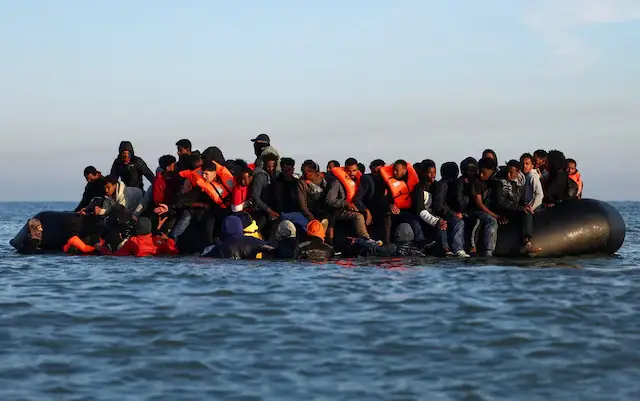
For too long, Britain's debate over small boats crossing the English Channel has been viewed almost exclusively through the lens of immigration and humanitarianism. While compassion should always play a role in our asylum system, it cannot be the only consideration. Border security is, first and foremost, a matter of national security.
This is not an argument against legal immigration or against offering sanctuary to genuine refugees. Britain has a long tradition of protecting those fleeing persecution. That tradition is worth defending. But a compassionate asylum system depends upon public confidence—and public confidence depends on the Government demonstrating that it knows who is entering the country and that those who pose a danger can be identified and dealt with effectively.
The Security Environment Has Changed
The security threats facing Britain today extend far beyond conventional military conflict. MI5 has repeatedly warned that hostile states are increasingly willing to conduct espionage, intimidation and covert operations on British soil. In public speeches and government statements, officials have highlighted a marked increase in Iranian state activity directed at people in the UK, including dissidents, journalists and Jewish communities. MI5 Director General Ken McCallum has said the Security Service tracked more than 20 potentially lethal Iran-backed plots over a recent twelve-month period, while the Government has described Iran as posing an unacceptable state threat to UK security.
These warnings matter because they remind us that hostile states actively look for weaknesses they can exploit. Whether through cyber-attacks, espionage, proxies or covert operatives, adversaries seek opportunities wherever they exist.
That does not mean there is public evidence that significant numbers of people arriving in small boats are agents of the Iranian regime or the IRGC. There is no such evidence in the public domain. But recognising that fact should not prevent policymakers from asking whether irregular migration routes represent a vulnerability that hostile actors could seek to exploit.
National security planning is about reducing risk before it materialises—not after.
Organised Criminal Networks Already Exploit the Border
One point is beyond dispute: the Channel crossings are organised by sophisticated criminal gangs.
These gangs charge thousands of pounds to transport people across one of the busiest shipping lanes in the world, frequently using overcrowded inflatable boats with inadequate safety equipment. Their business model depends upon exploiting weaknesses in border enforcement while showing little regard for the lives of those they transport.
Recognising the danger posed by these crossings, Parliament introduced new criminal offences targeting those who pilot small boats and endanger lives. In 2026, the first offenders were jailed under these provisions after admitting to steering dangerously overloaded vessels carrying dozens of migrants. Prosecutors described the crossings as placing lives at serious risk and emphasised the determination of law enforcement agencies to dismantle the organised crime groups behind them.
If organised criminal networks can move thousands of people illegally across Europe into Britain, it is reasonable to ask whether those same routes could also be exploited by terrorists, violent extremists or hostile state actors.
Why Documented Cases Matter
Critics sometimes argue that there is no connection between illegal migration and national security.
That overstates the case.
The overwhelming majority of people arriving by small boat have never been convicted of terrorism or serious violent crime. It is important to acknowledge that reality.
However, documented exceptions demonstrate why security screening cannot be treated as a formality.
In December 2025, Iraqi national Rebwar Hamad, who had previously been convicted of terrorism offences in Italy, was jailed after illegally re-entering the United Kingdom in a small boat. According to the Crown Prosecution Service, he had previously been extradited to Italy to serve his terrorism sentence before later paying a smuggling gang to return to Britain after his visa application was refused.
Cases such as this do not prove that illegal migration is synonymous with terrorism. They do demonstrate, however, that individuals with terrorism convictions have successfully used irregular migration routes to enter the UK.
Similarly, other cases have involved individuals who entered Britain illegally before later committing serious offences. These cases reinforce the principle that robust screening, identity verification and intelligence sharing are essential—not because every arrival presents a threat, but because governments have a duty to identify those who do.
Deportation Should Be the Presumption for Serious Foreign Offenders
Perhaps the issue that most undermines public confidence is what happens after a foreign national commits a serious offence in Britain.
The criminal courts exist to punish wrongdoing. A prison sentence reflects the seriousness of the crime committed.
But where a foreign national has no lawful right to remain in the United Kingdom and is convicted of terrorism, violent offending or other offences demonstrating that they present an ongoing risk to the public, deportation should ordinarily be the default outcome once that custodial sentence has been completed—provided that removal can be carried out consistently with UK law and the country's international obligations.
This is not about imposing a second punishment.
It is about recognising that the Government's first responsibility is to protect the public.
The law rightly prevents deportation where there is a real risk of torture, persecution or other serious human rights violations. Those safeguards exist for important reasons. Nevertheless, where removal is lawful, the presumption should favour deportation rather than indefinite residence for those who have demonstrated through serious criminal conduct that they present a continuing danger.
A Secure Border and a Fair Asylum System Go Together
Too often, the immigration debate is presented as a choice between compassion and security.
It is a false choice.
A secure border protects genuine refugees by giving the public confidence that asylum claims are assessed fairly and that those granted protection have been properly identified.
It protects taxpayers by ensuring that finite resources are directed towards those with legitimate claims.
And above all, it protects the public by reducing opportunities for organised criminals, terrorists and other dangerous individuals to exploit weaknesses in the system.
The first duty of government is the safety of its citizens. Meeting that duty requires more than rhetoric. It requires secure borders, effective intelligence, robust screening, swift decisions on asylum claims and, where the law permits, the removal of serious foreign offenders who have no right to remain.
That is not a rejection of Britain's humanitarian tradition.
It is how that tradition is sustained.
Add comment
Comments